AI See
Real-time defect detection on factory conveyor belts, from the camera to the dashboard.
No public link: it runs on-premises on the client's industrial machines, behind Tailscale VPN.
- Client
- Private, industrial
- My part
- The pipeline around the model, the results dashboard, the feedback loop and the on-prem deployment
- Type
- Computer vision, quality inspection
- Hosting
- On-premises, behind Tailscale
- Built with
- React, NestJS, Microservices, C++, AI inspection
The product
Products move along a conveyor belt and cameras take a photo of each one. AI See checks every photo for defects, so a damaged part is caught before anything ships, and every defect shows up live on a dashboard.
The vision model was trained separately. I built everything that turns it into a working system: integrating the model into the pipeline, processing its results, showing them on a dashboard, collecting their feedback for the next round of training, and deploying the whole thing on the client's own machines.
Finding the defects
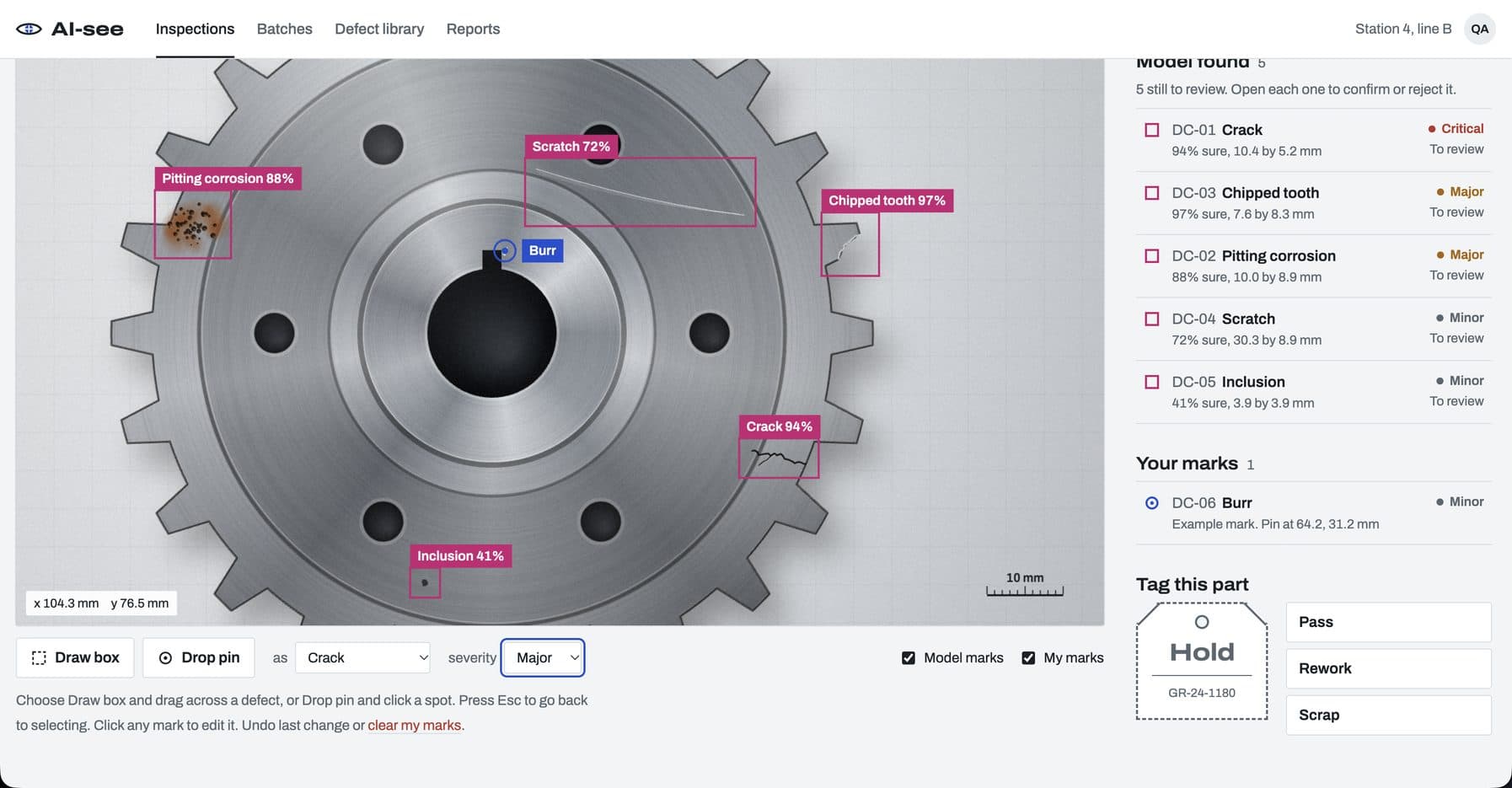
The model inspects each image. It draws a box around every defect it finds and labels it, so on the gear in the screenshot above it marks a crack, a chipped tooth, a scratch and corrosion separately.
Each defect comes with a confidence score and a severity, and they're listed beside the image for review. That way a person can see what the model found and how sure it was, not just a pass or fail.
Human feedback for the next model
When a reviewer checks the model's results, their feedback is stored alongside the image and the model's output. That builds a set of human-checked examples from real production images, which goes back into training the next version of the model.
From camera to dashboard
The system is built as independent microservices, one for each stage of the pipeline.
- Camera service, written in C++, feeding images straight into the pipeline.
- File uploader, which takes the images in.
- AI inspection, which runs the model on each image.
- Post-processor, which works on the model's results before they reach the dashboard.
- Main backend in NestJS, which the dashboard talks to.
- Frontend in React: the dashboard that surfaces defects the moment they're found.
Deployed on-premises
AI See doesn't run in the cloud. I deployed it on the client's own industrial machines, reachable only over Tailscale VPN. That's also why there's no public link to show.